
Fundraising for Impact VCs in 2026

Updated: May 7
Key Themes & Takeaways from a Peer Discussion with Impact GPs and LPs
24 March 2026 | Central London
As ImpactVC enters its third year, we are sharpening our mission, which in turn shapes the convenings, tools, and resources we create. ImpactVC supports VCs in staying at the forefront of their craft across both impact and venture, while fostering high-quality dialogue and collaboration with LPs through our community, events, resources, and learning opportunities.
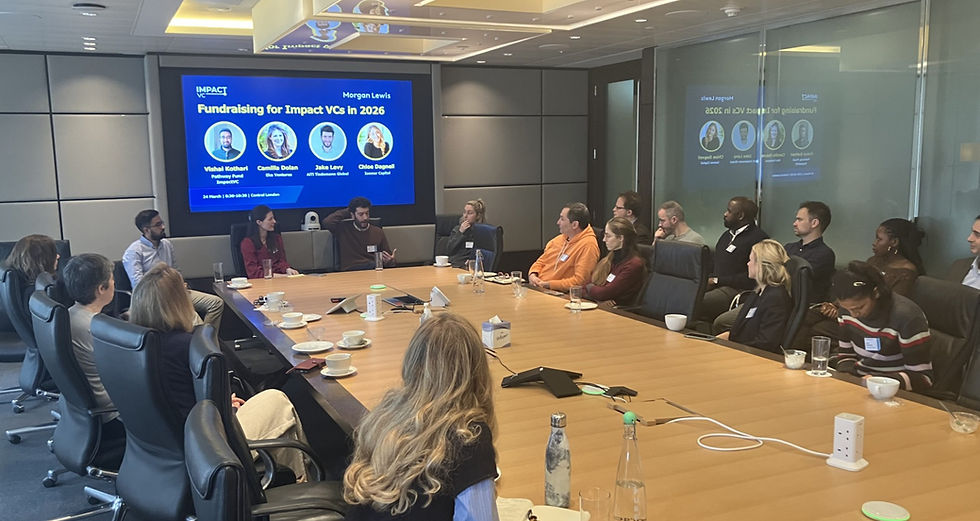
As part of our aim to elevate LP–GP dialogue on impact, and set against a backdrop of shifting macroeconomic conditions, evolving political consensus around impact (particularly climate), and an AI-dominated market, we brought together a group of impact-focused GPs and LPs in central London. A show of hands at the outset indicated that almost all VCs in the room were raising, or preparing to raise - underscoring the timeliness of the discussion. The session centred on candid reflections on what it takes to raise an impact fund in 2026 - whether as a first-time manager or when raising Fund II or III.
With perspectives from Jake Levy, AlTi Tiedemann Global, Chloe Dagnell, Isomer Capital, Camilla Dolan, Eka Ventures, and Vishal Kothari, Pathway Fund, with inputs from Better Society Capital, we aimed to create a space for more open, constructive LP–GP dialogue on impact, and to surface practical insights and fundraising lessons. With thanks to our partners, Morgan Lewis & Bockius LLP.
The state of the venture market and how different investors are responding to ‘impact’
Participants reflected that shifting macroeconomic conditions have influenced how impact features in fundraising conversations, with reception varying by LP type. More broadly, the current fundraising environment remains challenging for all managers - particularly for smaller or emerging managers - across venture as a whole, not only within the impact space.
While the post-Paris Agreement wave of climate capital that peaked in 2019–20 has yet to translate into the level of market maturity some LPs had anticipated, there was recognition that the landscape is continuing to evolve. Policy developments globally, a growing focus on energy security, and shifts in tone in the US are all shaping how impact is framed and received. Against this backdrop, managers are adapting their narratives to resonate with a wider range of LP priorities while maintaining their core impact ambitions.
Key takeaways:
Many VCs are choosing to lead with economics first. Several GPs noted a deliberate shift in sequencing - economic returns now lead the LP conversation - less so with foundations and family offices, but particularly with institutional investors and fund-of-funds - with impact framed as a value driver. It was noted that GPs shouldn’t dilute their conviction, but consider changes in sequencing their narrative.
"Impact" and "ESG" are loaded terms in the US. GPs raising transatlantically need to tailor their language carefully - while simultaneously demonstrating that impact is integral to the strategy and drives value, not a bolt-on. LPs want to know GPs own the impact thesis authentically and can answer questions on it, not just deferring the impact questions to the Head of Impact.
Hold the narrative, flex the examples. The overarching thesis should remain consistent, but its expression can be tailored. Which portfolio companies you foreground in LP discussions is a powerful lever: emphasise health outcomes with health-focused LPs, climate solutions with climate-focused ones. The strategy stays fixed; the illustration adapts. This makes thorough LP research essential - understanding their priorities and where your fund fits.
Coaching on impact articulation can be valuable. One GP highlighted how structured work with an external communications coach, supporting both GPs at the fund, helped refine storytelling and tailor the narrative for different LP groups. This was not just a communications exercise - it also strengthened internal alignment around what the team genuinely believes, and ensured that their thesis and portfolio case studies were conveyed effectively.
LP Appetite Is Segmenting - Know Which Segment You're Pitching
LP appetite can be seen to have segmented. The discussion surfaced meaningful variation across LP type, geography, and mandate, and the GPs with the best conversion rates were those who had mapped this carefully.
What's working:
Impact investors with with full and explicit commitment to impact remain a core, reliable segment
Making the UK case is an opportunity. While Brexit-related friction, comparatively thinner DPI track records versus the US, and lower familiarity with the UK ecosystem can pose challenges, a clearly framed narrative - supported by concrete examples of where impact drives value in your portfolio - can be highly effective. This is particularly true with European LPs, with Germany cited as an especially active base for engagement. Soft introductions from other GP to LPs was shared as a useful route to connect with LPs.
Family offices are highly idiosyncratic - each is its own island. Loose pattern: where a family member is active in the core business, impact themes need to align with the business or their personal interest. Where a professional team manages assets without family involvement, the focus shifts to diversification and risk-adjusted returns rather than thematic conviction. Some family offices are also increasingly seeking to align philanthropic activity with private investment - a trend worth watching.
Global FoFs with an impact flavour are leaning into deep tech and IP-creation as the lens through which they reconcile impact with return targets - particularly as AI dominates generalist comparables.
Find your aligned LP segment and go deep, not broad. Conversion comes from alignment, not volume of conversations. The temptation to pursue every LP with a vague impact flavour can waste time that should go to the segments with genuine structural and strategic fit.
What's working less:
Global FoFs without impact mandates are benchmarking impact funds against generalist AI-era funds. The return trajectory can look quite different, and can be a long and slow to evolve conversation.
US LPs in venture remain largely unconvinced on European exposure to impact - established relationships and perceived opportunity concentration keep them US-side. More movement in buyout than venture, where Europe has stronger DPI track records. Curiosity exists but hasn't converted.
DPI and Distributions Dominate
We discussed how expectations around DPI and realised value are shaping fundraising conversations. While early-stage impact funds are not typically expected to demonstrate significant DPI by Fund II, there is nonetheless increasing scrutiny from LPs on how and when value will be realised. Managers are being asked to articulate a credible path to liquidity earlier, and with greater specificity.
Key takeaways:
DPI dominates the conversation. LPs are increasingly focused on realised value and what is credibly on track to be realised - rather than paper mark-ups. For impact VCs, even at early stage, being able to point to tangible examples of DPI generation within the portfolio is becoming a critical part of the underwriting story.
Exit strategy needs to be designed early. It is no longer sufficient to treat exits as an end-stage consideration. GPs should be working with founders at least 2+ years ahead of any potential transaction - mapping likely acquirers, positioning for growth-stage investors, and being realistic about which companies can attract generalist capital (where much of the funding sits). This remains structurally more challenging for impact funds, given a thinner pool of aligned growth investors. We hosted a roundtable on impact sustainment on exit last year - you can access the write up here.
Secondaries are becoming a real tool. For funds approaching year 9–10 with long-dated assets, secondary sales are increasingly viable as an LP liquidity mechanism - GPs shouldn't feel compelled to run every company from seed to exit.
A shift towards defensible, IP-led and strategically critical sectors
There was broad agreement that the centre of gravity in impact investing is moving towards areas where intellectual property is being created and long-term, defensible value can be built. By contrast, application-layer businesses are increasingly being challenged in LP conversations — particularly where they are seen as vulnerable to AI-native disruption.
Key takeaways:
Map where the IP sits. A central question for LPs is where real, defensible value is being created. Impact GPs should be explicit about this in portfolio construction and in fundraising - clearly articulating where proprietary technology, data or infrastructure underpins outcomes, rather than relying on thinner application-layer models.
The best GPs are ahead of the curve. LP confidence is strongest where there is clear evidence that a GP was positioning their portfolio 4–5 years ahead of market shifts - not reacting to them. Forward-looking conviction, backed by portfolio evidence, is a powerful differentiator.
SaaS model risk is now explicit. The traditional per-seat SaaS model is under structural pressure from AI. LPs are actively interrogating exposure here, and GPs who can demonstrate that their portfolios have already been stress-tested - ideally well before this became consensus - have a clear advantage.
Defence and security are emerging as durable themes. Defence tech, and more broadly security and resilience, are increasingly being underwritten as long-term structural opportunities rather than cyclical bets. Persistent underinvestment in European defence capability reinforces this view.
Implications for impact funds. For some LPs, these themes, particularly where tied to sovereignty, resilience and infrastructure, are becoming as compelling as, or in some cases more immediately investable than, impact verticals. This does not displace impact, but it does raise the bar: impact strategies need to show how they drive long-term value and relevance. Access our write up exploring what dual use and defence means for impact focused VCs here.
Final thoughts
The overarching takeaway from the room was not pessimism, but recalibration. The impact funds that are winning LP conversations in 2026 are those that have sharpened their economics, connected this to where impact drives business value creation, mapped their LP segments rigorously (across institutions, family offices and foundations), and built credible exit strategies. The bar may be high, but the opportunity - for managers who can meet it - is real, and the capital is available for those who can make the case.
Thanks for making it through this write up. ImpactVC is increasingly focused on elevating and advancing LP–GP dialogue around impact. What else would be useful to support this - events, tools, resources, market maps of funders? Let us know your thoughts.


